
Offering New Opportunities and Removing Barriers: Celebrating the Launch of the CAPS Apprenticeship Program
In 2026, we are expanding paid opportunities for youth by introducing a new paid apprenticeship program. This program aims to enhance training, strengthen connections with employers, and provide support to help more young people persist in their education.
This program became possible thanks to a $500,000 planning grant from the California Opportunity Youth Apprenticeship (COYA) initiative, awarded by the California Department of Industrial Relations (DIR) and its Division of Apprenticeship Standards. As part of its work, the COYA grant funded the establishment of the California Youth Apprenticeship Committee (CYAC).
CAPS founder and Director of Energy & Sustainability Programs Bill Kelly was one of 19 members of the CYAC, tasked with “creating clear definitions for youth and high school apprenticeship, developing guiding principles for the Youth Apprenticeship Grant Program, and offering insights on the structure of the state’s work to expand youth apprenticeship.”
The state of California is committed to supporting apprenticeship programs as a way to provide youth with structured, affordable, and secure pathways into good-paying careers. “The California Department of Education aims to ensure our K–12 career technical education ecosystem is adequately preparing students for industry by building integrated apprenticeship and CTE systems across the state,” says Allison Frenzel, education programs specialist with the California Department of Education’s Academy, Apprenticeship, and Internships Office.
Bill says the Committee helped bring forth and shape two large and compelling ideas to further the impact of the CAPS program on youth through an apprenticeship program:
At the core of any apprenticeship is instruction combined with on-the-job (OJT) training. CAPS internships primarily focus on project work and OJT. By combining CAPS’ extracurricular OJT training with aligned instruction, the apprenticeship program will leverage students’ time in the classroom to prepare them for great careers in sustainability.
CAPS’ internship program includes 200 to 400 hours of paid OJT for youth. The apprenticeship model will expand both OJT and employer engagement, including providing OJT after students cross from high school to college and careers, helping support youth interested in careers in the expanding professional field of sustainability.
“I see developing a CAPS apprenticeship program as a means to really advance our mission of providing opportunities for youth in underserved communities while working to create a more sustainable economy,” Bill says.
Providing New Opportunities to Underserved Students
While CAPS plans to continue supporting and growing our proven paid internship model, the new apprenticeship program offers expanded training and additional support. “Not all CAPS interns will go into the apprenticeship program,” Bill says. “It's designed for those students who identify an area they really want to invest in and pursue as a career. Those who sign up have to be really motivated for these sustainability careers.”
To ensure the program develops the skills needed to succeed in these careers, CAPS leadership leaned on its network of industry partners, who are helping to shape and direct the program. CAPS program director Renée Solari played an instrumental role in shaping the new apprenticeship program. “The industry is telling us directly, ‘these are the things we really need,’” Renée says. “We are working with our industry partners and school districts to triangulate the most important skills, and then we're developing our instruction and training to help build those skills.”
By working directly with industry partners, CAPS helps ensure a mutually beneficial relationship, preparing students for the skills they’ll need to succeed in lucrative green economy jobs. “If you talk to employers, as we have, they say, 'Here's what we need employees to be good at: A, B, C, D. And, boy, it would be amazing if you could develop people with those skills,’” Bill says. “A lot of what they refer to are not technical skills, such as energy modeling or Autodesk, but the ability to work with other people, to collaborate, to advocate for your ideas respectfully, to listen, to work in an ambiguous environment, and to figure things out on your own. We hope to help students develop those competencies at this critical developmental time of their lives.”
Renée adds: “During our interviews and exploratory sessions with companies, we found that they have concerns about the preparedness of entry-level employees, whether they have a high school diploma or a college degree. We’re designing this apprenticeship program to give the companies that work with us high confidence that students who complete it will be well prepared, vetted, and trained. If you have that assurance that your potential employee already has had a positive experience, and you already know them, you’re more likely to believe they’re going to be successful.”
To fulfill our mission of providing opportunities for students in underserved communities, the CAPS’ leadership team recognizes that students may also need support beyond career or technical training. Students in the apprenticeship program will have access to individualized support staff who can help them navigate challenges and find relevant resources and solutions. “One of our goals is to offer additional support services as part of our long-term commitment to help reduce barriers for students,” Bill says. “Those barriers might be related to practical factors, such as transportation limitations or access to technology. Or they could be around mental health or administrative things, like applying for community college or creating a resume.”
Supporting the Green Economy of the Future
The apprenticeship program is an elegant addition to CAPS, as it directly aligns with both elements of our mission: providing opportunities to youth and advancing the green economy of the future.
“I am so excited about the idea of this program empowering young people to join the movement toward a sustainable economy,” Bill says. “It really resonates with our mission to create great opportunities for young people in under-resourced communities while also helping develop a sustainable economy. I love to imagine us stepping back in a few years and saying, ‘Wow, 50 of our former apprentices are now forces in their field,’ whether it’s in buildings, transportation, the natural environment, food systems, or whatever they end up working in.”
Like all effective programs, the CAPS apprenticeship program will set aligned metrics to enable us to monitor and optimize its success. “We’re considering our metrics,” Renée says. “What are indicators of success? One of them will be about employment. Where do interns and apprentices go next? Have they entered a related field of study in college? How many attain work in their target industry? How did the apprenticeship shape the direction they go? We hope their participation helps them choose a successful career in the green economy, but even if not, hopefully the skills they learn influence the way they work and how they show up in their career.”
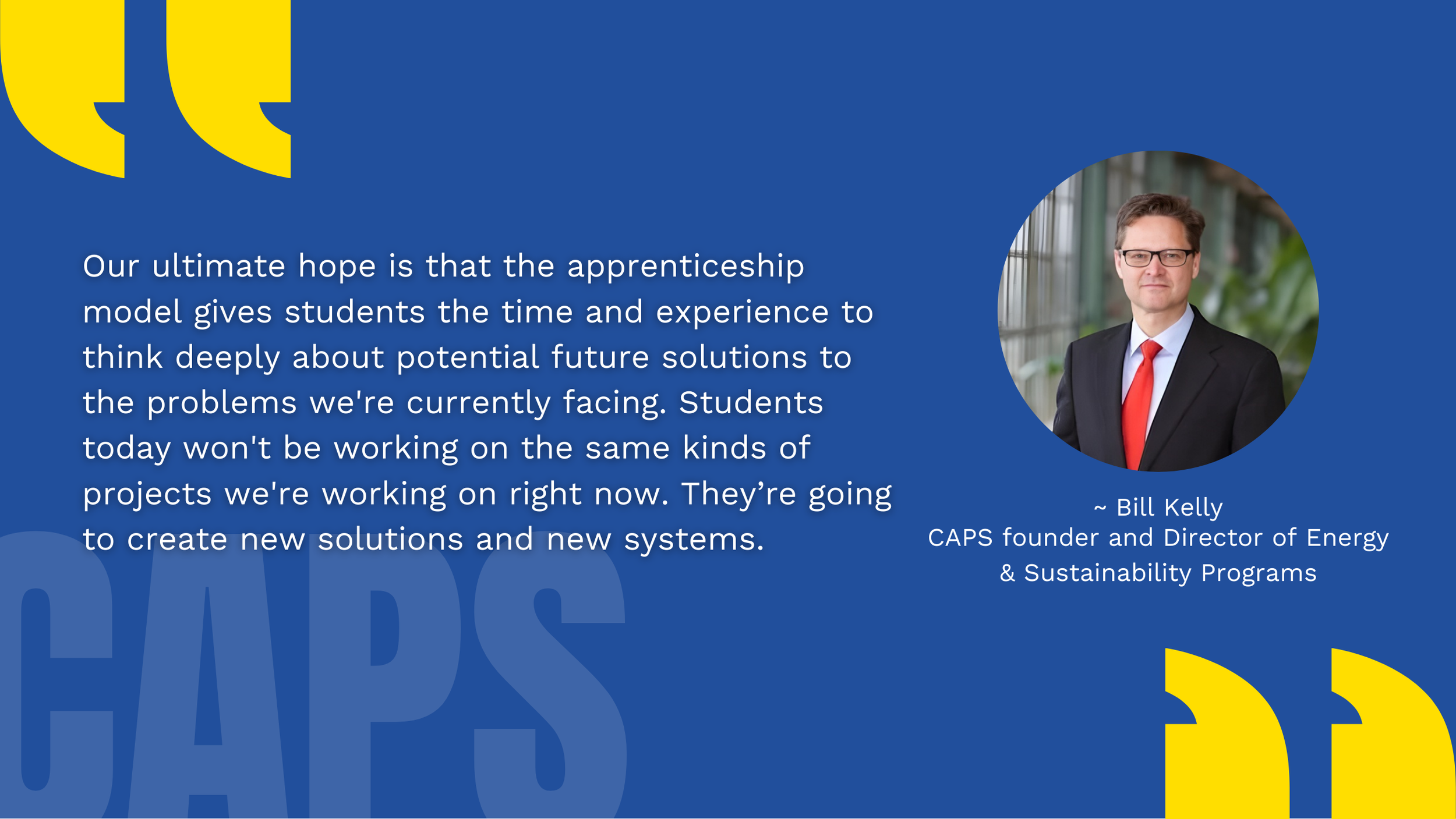
“Our ultimate hope is that the apprenticeship model gives students the time and experience to think more deeply about potential future solutions to the problems we're currently facing,” Bill says. “Students today won't be working on the same kinds of projects we're working on right now. They’re going to create new solutions and new systems. We want to help them develop the tools to innovate and do new things, maybe revolutionary things.”
To keep up with the latest and support CAPS:
Donate to support CAPS student interns in taking climate action in their local community.
Learning more about CAPS industry partnership opportunities.